In the 1600s, Spanish women could be barred from church for showing their shoulders, fined for the size of their skirts, or punished for lace or cosmetics deemed indecent—sins of fabric and flesh policed by kings and clergy alike, in a society where 17th-century Spanish fashion became a battleground for morality, power, and control.
“It was one of the most extreme and shocking eras of fashion history,” the curator of “Spanish Style: Fashion Illuminated, 1550–1700” Amanda Wunder told me earlier this month during a preview.
The exhibition runs until March 22, 2026 at the Hispanic Society Museum & Library in New York’s Washington Heights. “Fashion wasn’t about individuality and personal expression back then,” Wunder said. “It was about belonging.” And the cost of not belonging was nothing to scoff at.

Installation view of “Spanish Style: Fashion Illuminated, 1550–1700.” Courtesy of the Hispanic Society Museum & Library.
Spanish tailors were famous for the quality of their work. Clothes were cut tight to the body. Comfort wasn’t factored in. At the height of the empire, appearance was a form of governance. The Habsburg kings issued decrees that dictated what their subjects could and could not wear, while the Church condemned trends as sins of the flesh. The styles that most deeply triggered and tantalized Habsburg society’s psyche were the ruffled collar, the plunging neckline, and the side-broadening hooped guardainfante.
The Hoop that Shocked Madrid
No garment caused as much outrage as the guardainfante, which translates to “hide the infant”, a type of farthingale. This scandalous garment was a bell-shaped cage of wire and ribbon that inflated women’s skirts into architectural domes, eventually developing into a massive rectangular shape. Critics accused women of wearing them to cover up baby bumps from shameful pregnancies. To wear the hoop skirt was to invite gossip—a woman’s virtue, and her husband’s honor, immediately called into question.

Unknown Spanish painter, Mariana of Austria, Queen of Spain, ca. 1650-1651. Courtesy of Hispanic Society Museum.
Philip IV outlawed the guardainfante in 1639 for all women except prostitutes—but his own wife, Isabel of Bourbon, defied his decree, wearing one to mass. “They didn’t follow that rule,” Wunder says. “When the queens kept wearing them, everyone else did too.”
In Spanish society, rigid clothing signaled more than just wealth—it exemplified immobility as privilege. “You can’t walk fast or work in a garment like that,” Wunder says. “It announces that your body exists only to be looked at.” The sculptural silhouette spread through the empire, from Seville to Mexico City, despite its prohibition. One anonymous portrait shows a woman in brown silk and metallic lace, corseted so tightly “there was no place to hide a baby bump,” as the wall text wryly notes.
The Collar That Toppled an Empire
Men were not spared from the fashion police. “Usually, you see women are the political scapegoats, but actually men’s fashion was very controversial too,” Wunder explained. “It was all about gender.”
The ruff—a stiff halo of pleated white lace and linen starched into radiance—had once symbolized power, purity, and excess. The dramatic collar forced wearers to assume haughty poses, holding their chin up. At their most extravagant, the ruffs, which originated in Spain before spreading across Europe, grew so large that special elongated utensils had to be invented just to allow wearers to eat.

Paintings from 1612 to 1613 of Anna and Phillip, the children of Phillip III. Courtesy Hispanic Society Museum.
By the early 1600s, the ruff had become a national embarrassment. After Spain’s military defeats and economic decline, moralists blamed the effeminate, frilled collar as a symbol of imperial decay. “There’s this rhetoric that Spain fell because its men had become too soft,” Wunder said. “The ruff became the scapegoat.” Philip IV outlawed it in 1623, ordering shorter hair and simpler collars to “make Spain great again,” as Wunder puts it with a knowing laugh.

Unknown Artist, Portrait of María, Queen of Hungary, Empress of Holy Roman Empire (1628-1646). Courtesy of the Hispanic Society of America.
The Neckline That Led to Excommunication
Ultimately, women’s bodies were under heavy scrutiny. Wunder traces how, over the century, “women at the beginning are really covered up, they’re really pious, and… by the end of the 1600s they are wearing very low-cut dresses, the shoulders are exposed.” Royal decrees outlawed low-cut bodices in 1639 and 1646; by 1668, the Archbishop of Zaragoza banned women from attending church “with any flesh of their backs, shoulders, or breasts exposed.” None of it worked.
“Women’s necklines crept lower and lower,” the exhibition text observes, while preachers railed against the “French influence” corrupting Spanish virtue. “The men, too,” Wunder elaborates, “go from a super buttoned-up, tight, military look to having long hair and billowing sleeves.”

Unknown artist, Figura de
Vestir, ca. 1825. Courtesy of Hispanic Society Museum.
Fashion’s Dynasty and Its Drift
But who were the trendsetters that decided what was in, and what was out in Spain in the 1600s? Unsurprisingly, the royals did.
“If the royal family followed their laws, then everybody followed it,” Wunder said. “So, in the case of the ruffled collar, Philip IV followed his own law. All the men did, but the queens continued to wear these low-cut collar and hoop skirt styles, so everybody else did too.”
One such icon of Spanish fashion was Mariana of Austria, who reigned from 1649-1665. In a stunning portrait at the exhibit by Diego Velázquez, the queen wears a black and silver behemoth of a dress inflated by her guardainfante into a rectangle. When she arrived in Madrid from Vienna in 1649, she set the template for a new, transcendently grand court style.
After King Charles II died without an heir in 1700, Spanish court dress—once the envy of Europe—fell out of favor. The new French Bourbon dynasty briefly clung to the guardainfante, but its reign was short-lived. As the Madrid court adopted the lighter, more fluid fashions of Versailles, the rigid architecture of Spanish style gave way to movement and air. Court protocol loosened, and with it came a modest but visible shift in women’s freedom—the fabric itself reflecting this breath of fresh air.
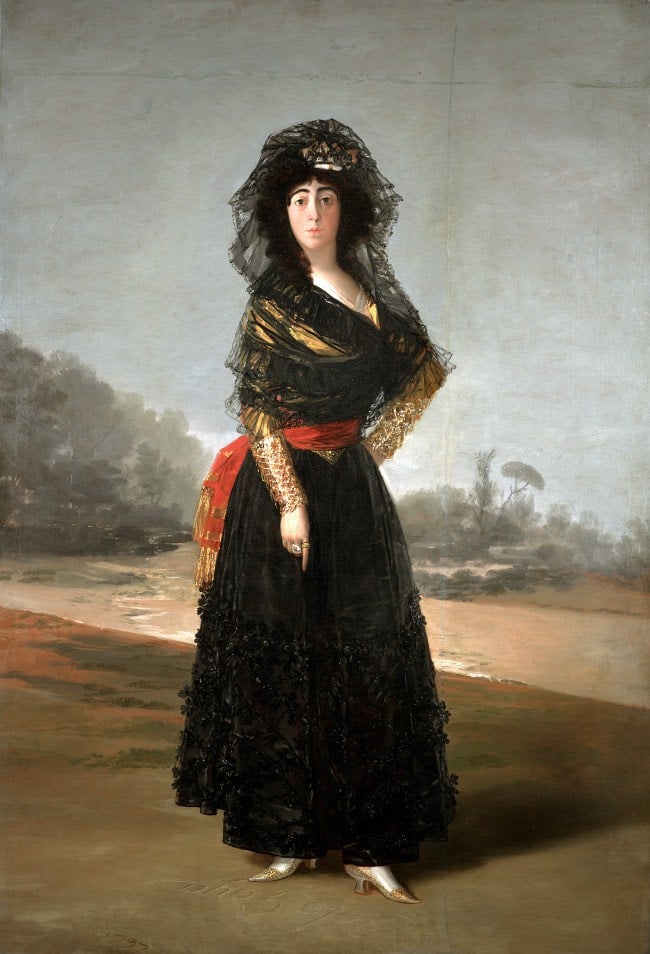
Francisco Goya Year, Portrait of the Duchess of Alba (1797). Collection of the Hispanic Society of America.
By the 18th century, when Paris had replaced Madrid as Europe’s fashion capital, Spain’s black palette and rigid tailoring adapted to survive as emblems of a lost austerity. The very severity that once denoted faith came to signify erotic mystery, an inheritance visible in Francisco Goya’s painting of the Duchess of Alba, at once seductive and domineering with her black lace mantilla and red sash.
Four hundred years later, these forbidden clothes and styles all remind us that fashion’s true and ever-enduring scandal is disobedience.
“Spanish Style: Fashion Illuminated, 1550–1700” is on view through March 22, 2026 at the Hispanic Society Museum & Library, 613 West 155th Street, New York, NY 10032.
link